

Swanderlust
The first Trumpeter Swan to reach New York City's shores, and the Mute Swan that welcomed it here.

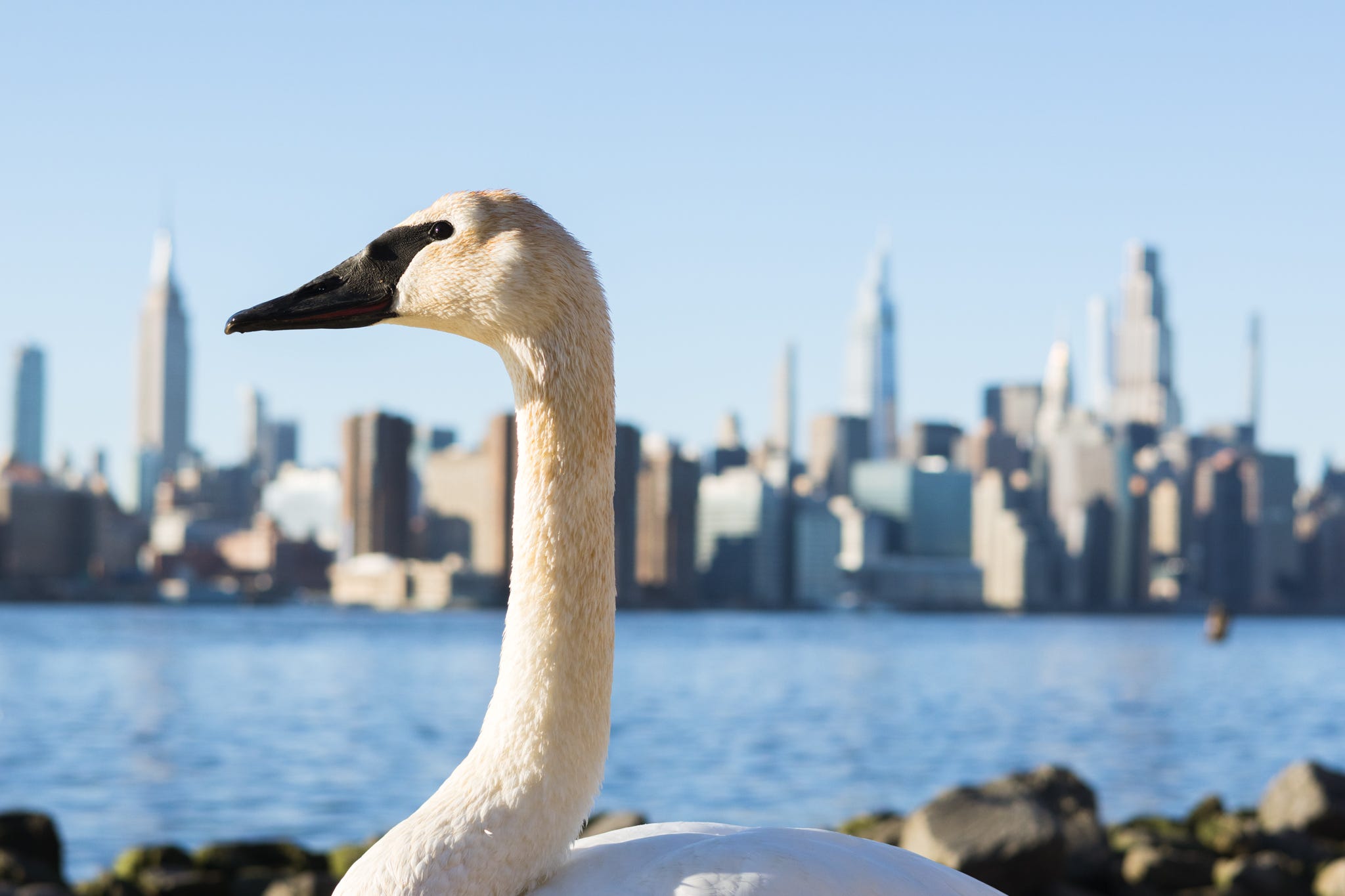
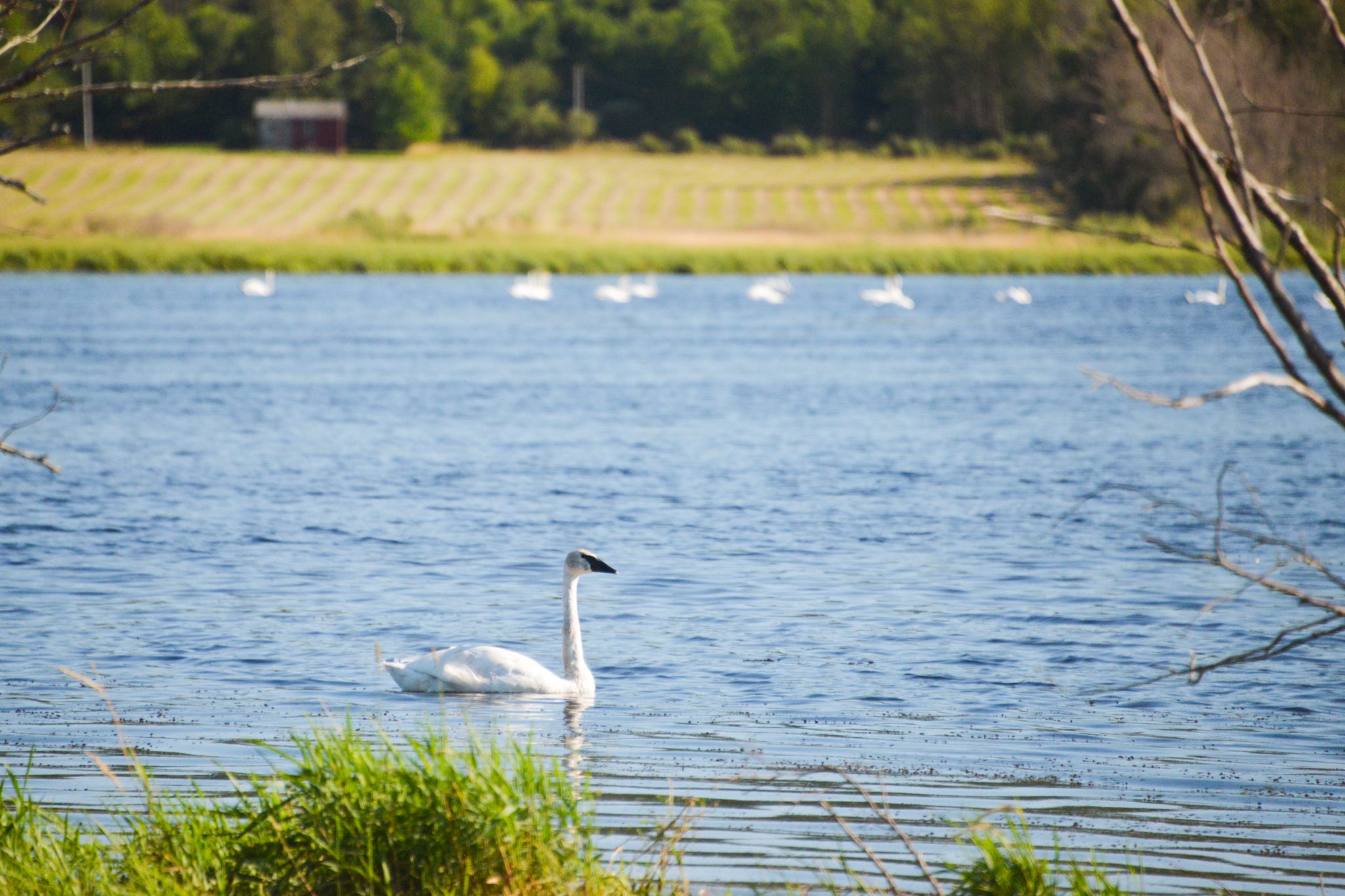
The Trumpeter Swan is best known as a majestic icon of great North American wildernesses, blossoming like a massive feathered water lily from the ponds, lakes, and rivers of the northern United States and Canada. It’s also one of the classic conservation success stories, a narrative of overhunting followed by careful captive breeding and reintroduction.
In Michigan, where I’ve seen them the most, they were extirpated by 1885. By 1930, fewer than 70 Trumpeters remained in the world, hanging on near Yellowstone. From these survivors, successful captive-breeding and reintroduction programs helped the population recover.
Until February 2026, birders had never before laid eyes on a wild Trumpeter Swan in the five boroughs of New York City, where I live. The species typically ranges no closer than Lake Erie, and it prefers fresh water. So when this particular Trumpeter Swan was spotted on the Brooklyn shore of the brackish East River, it was an instant star.
The Trumpeter Swan is the ideal avian charismatic megafauna: on the water, a dazzling white cloud; on the shore, an ungainly flat-footed beast. Up close, delicate spangles of toasted-marshmallow gold—stains from tannins in the iron-rich water it uses that long neck to forage in—glisten with water droplets on its head and neck, and a large jet-black eye gleams with inquiry, if not intellect.
This one was lucky to find a welcoming companion in one of the handful of non-native Mute Swans eking it out on the East River. (Though they’re not native here in New York, Mute Swans aren’t really disruptive enough to our already-disrupted ecosystems to warrant the epithet of “invasive.”) I think meeting this Trumpeter Swan was a stroke of luck for this particular Mute Swan, too. They’ve been inseparable
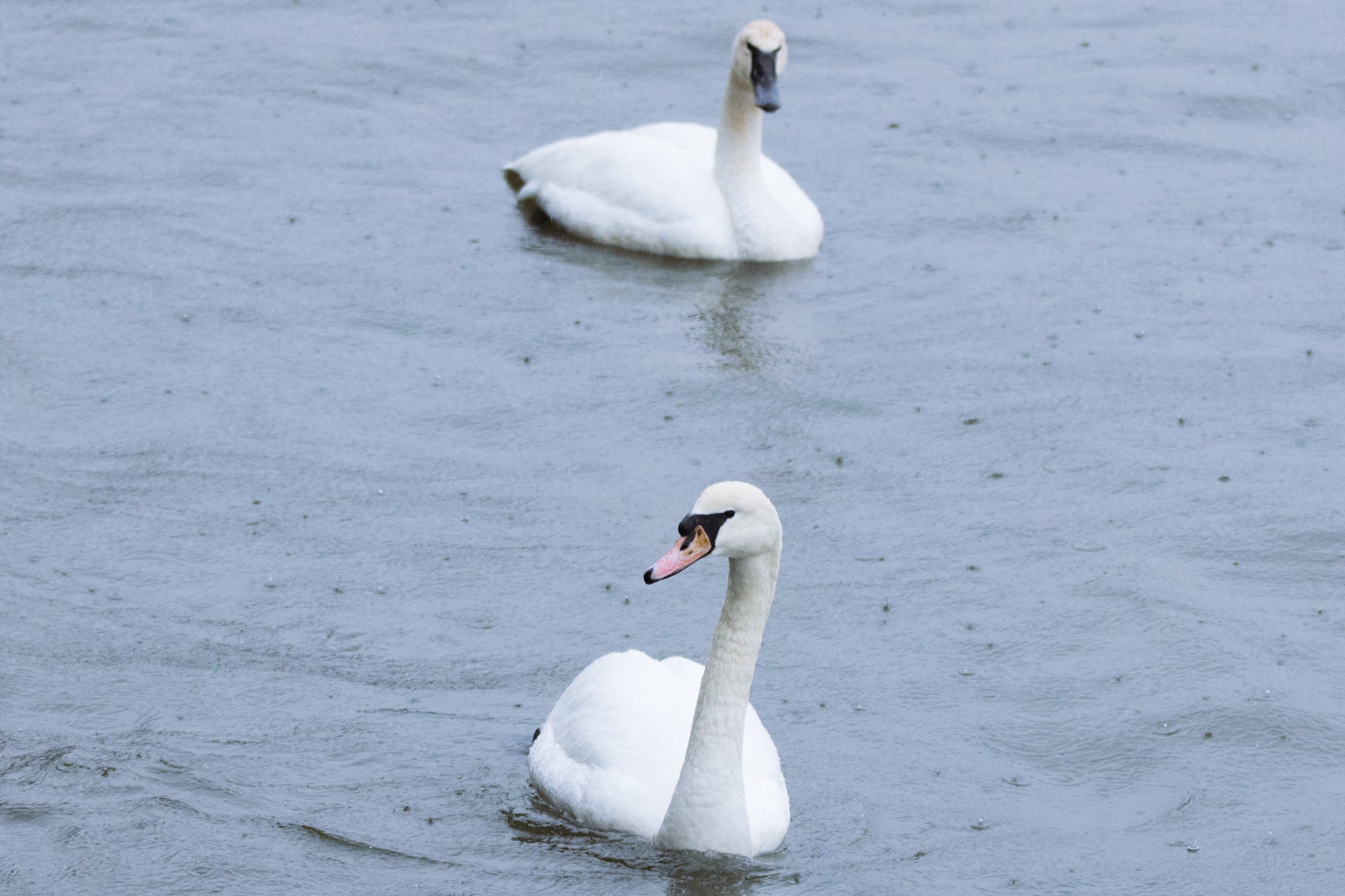
Until last year, a nicknamed pair of mated Mute Swans at Hallett’s Cove in Queens drew the affection of locals touched by their bond. Mute Swans mate for life, usually monogamously, acquiring a reputation for romance and loyalty.
But in late November, I heard that the male of the pair had died under suspicious circumstances. The New York Post later reported that he was euthanized for untreatable head trauma at a nearby animal shelter. According to the Post story, teenagers had previously been seen throwing rocks at the swans. Nothing seems to end well for a named wild bird in this city—RIP Flaco, Barry, and Rover.
The swan was survived by its female mate and one offspring, and I believe it was one of them that joined up with the visiting Trumpeter Swan. Since then, the Trumpeter–Mute duo has cruised the Williamsburg waterfront, a mile-and-a-half post-industrial stretch from Bushwick Inlet south to Wallabout Channel.
Birders rushed to the scene February 28 when patch birder Caroline Quinn made the first report of the Trumpeter Swan at the Austin Nichols House (named for a former grocery warehouse and liquor distillery that today offers “contemporary loft living”). Paul Saraceni, a veteran birder visiting from San Francisco, later uploaded an eBird checklist from February 27 with photos showing the bird at Marsha P. Johnson State Park, a former railroad terminal and dock. Saraceni had also visited the day before and wrote that the swans were not present then.
One more late-breaking checklist revealed the Trumpeter’s whereabouts that day—and the possible identities of its Mute Swan consort. In a checklist timestamped 9:20 p.m. on February 26, Kim Garrett (an environmental toxicologist not to be confused with Kimball Garrett of Los Angeles’ Natural History Museum) snapped an iPhone photo of two swans—one Trumpeter, one Mute—at Hallett’s Cove.
The next day, the duo left Hallett’s Cove in Queens, traveled about four miles downriver to Marsha P. Johnson State Park in Brooklyn, and haven’t been seen that far north since.
While a handful of individuals live in the upper reaches of the East River between Manhattan and Queens, eBird records suggest that Mute Swan was nearly unheard on the Brooklyn shore of the river until last year. That spring, then again that fall, a handful of sightings reported a single Mute Swan—at spots now frequented by the Trumpeter–Mute duo. Only two reports show two Mute Swans at once.
On the afternoon of November 27, Thanksgiving Day, Jason Zolle and a Ross T. recorded two Mute Swans at Marsha P. Johnson State Park. Though they didn’t take photos or note the swans’ age and sex, they may have been the last people to see the Hallett’s Cove pair together. It was later that night that the male of the pair was found near death on the Queens shore of the East River.
Then, one month later, Laura Goggin photographed an adult and immature Mute Swan at Wallabout Channel. These two swans seem to have been the Hallett’s Cove female and her offspring, wandering downriver to shores at least one of them explored earlier that year. Whichever one of them paired up with the Trumpeter Swan when it arrived at Hallett’s Cove soon led it back down south to Williamsburg, where they have remained since.
I joined many other admirers in paying the swans a visit that first weekend. A crowd of a couple dozen, about half of them birders, gathered on the gravel beach of Marsha P. Johnson State Park as the pair sauntered out of the water. They stood amid the crowd, evidently expecting to be fed.
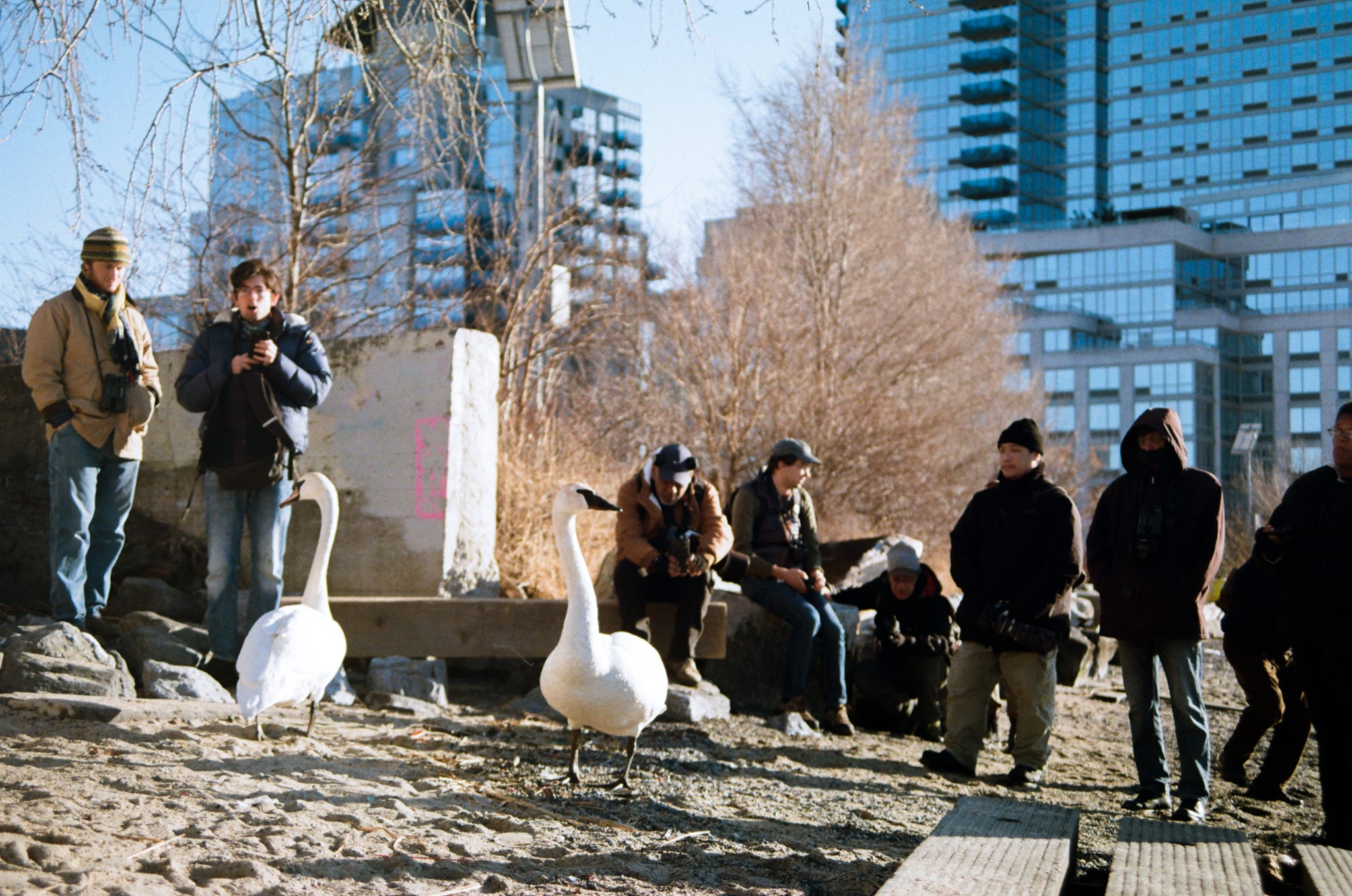
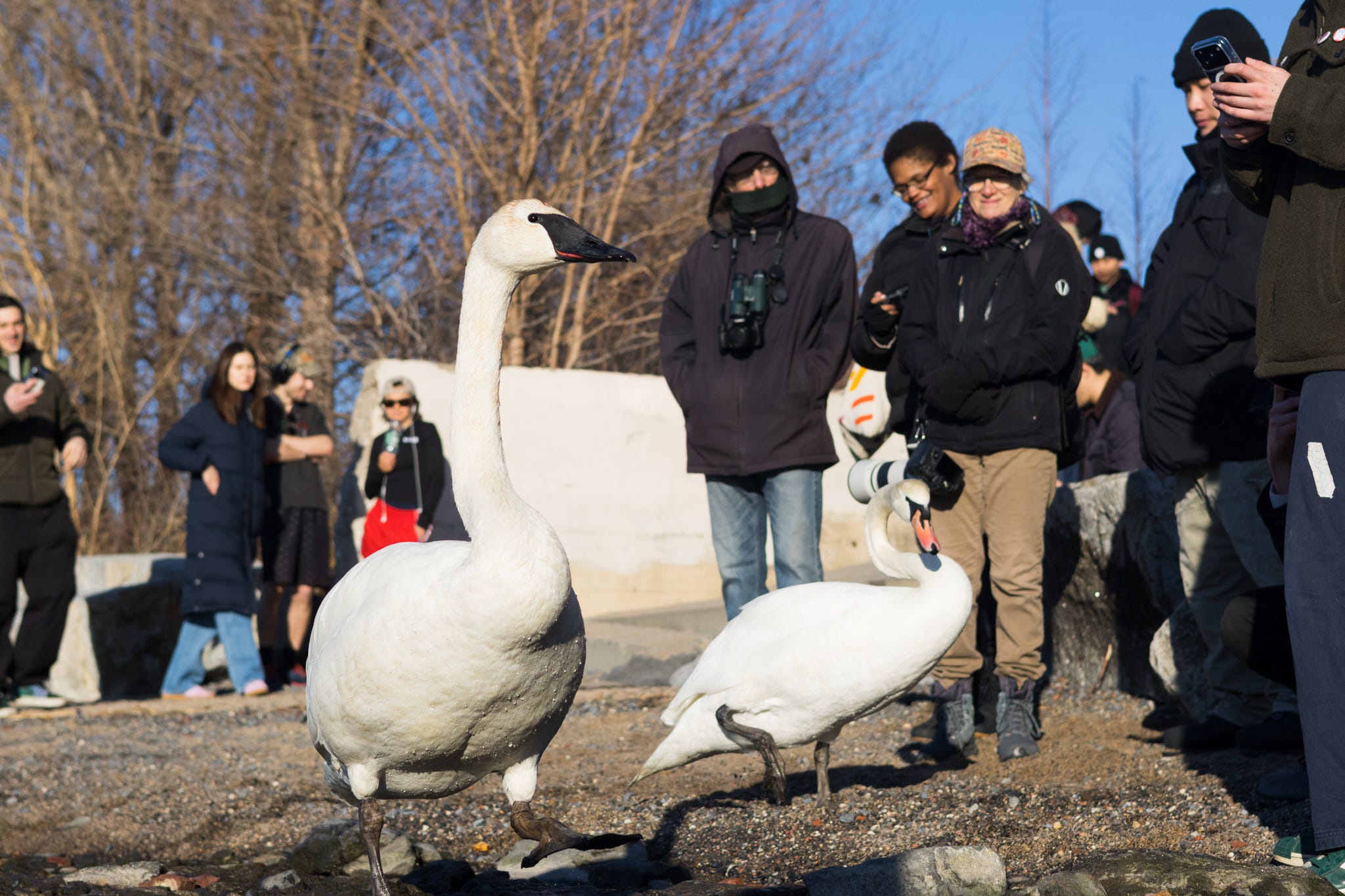
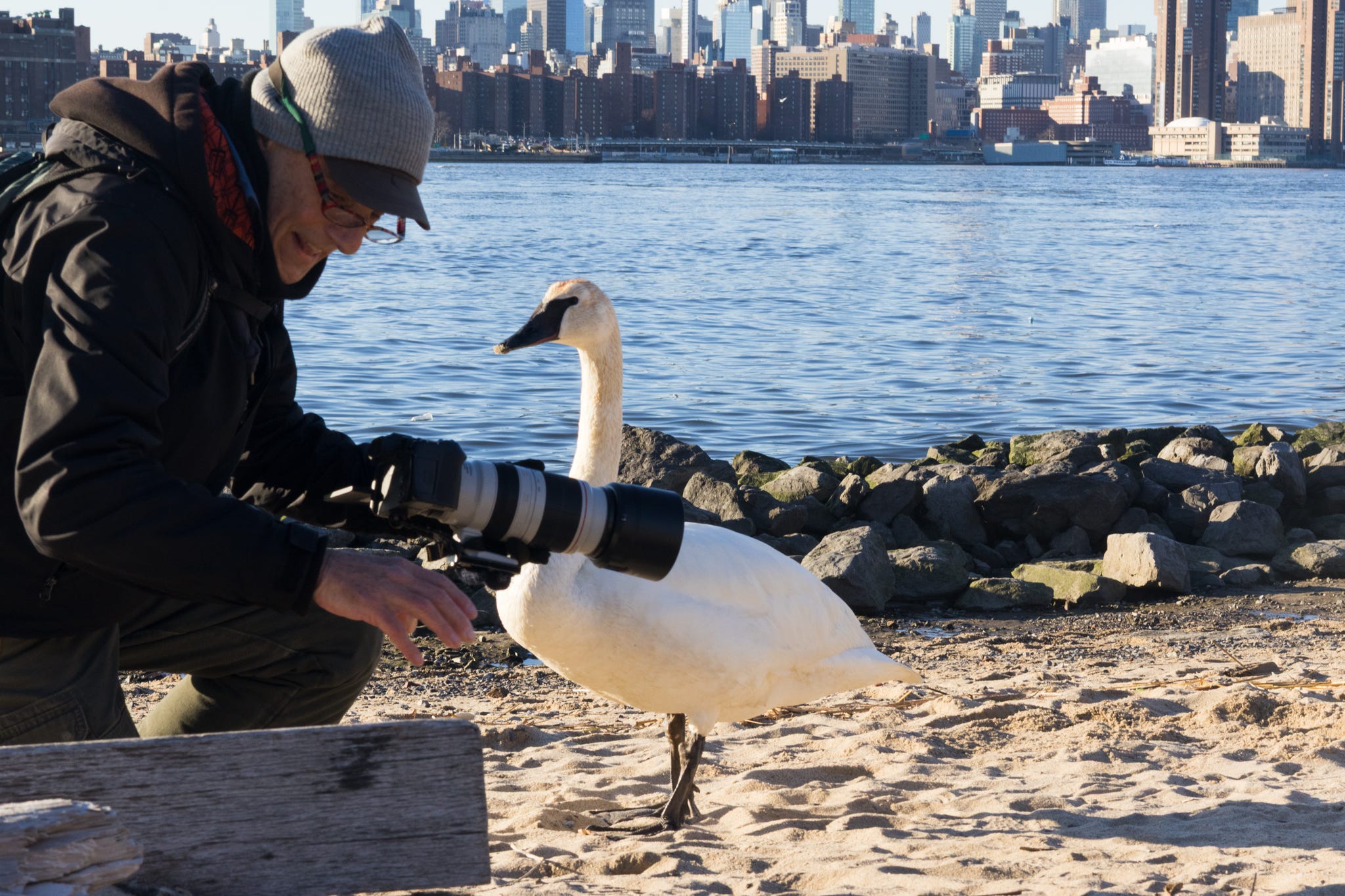
Falling in with a local helped this Trumpeter acclimate to urban life. Swans are social, looking to each other for behavioral cues; this duo took to begging for food as if the Williamsburg waterfront were an upscale duck pond. When the Trumpeter appeared at the end of February, several observers in birdwatching groups online marveled at it snacking on pizza.
Some birders wondered if they might be coupling up. It’s spring, after all! And they wouldn’t be the first such couple. Wild Mute Swans have produced documented hybrids with Trumpeter Swan, as well as with Whooper Swan, Black Swan, and even Graylag, Canada, and Swan Goose.
If this Mute Swan is the Hallett’s Cove female, it might be seeking a new mate. Widowed female Mute Swans, according to Birds of the World (which cites studies that I can’t find online), take a new mate as soon as three weeks after the old one’s death, and often choose a younger mate. If it’s the juvenile (which I’ve heard is a male, but I don’t know how this was ascertained), it could be about the same age as the Trumpeter—probably, but not certainly, too young to pair up. (The Trumpeter Swan’s Birds of the World account reports that they can couple up at as young as 20 months, but that firm pair bonds are unlikely until the third or fourth winter.)
The extent of the gray-brown feathers on the immature Mute Swan photographed in December suggests formative plumage, but I’m not confident that it wasn’t in second basic plumage, though. So when it met the Trumpeter Swan in February, this Mute Swan was either an adult female, a nine-month-old immature, or a 21-month-old immature.
Margaret Smith of the Trumpeter Swan Society, a Minnesota-based conservation organization, thinks they’re probably not a couple. In her opinion, the Trumpeter is too young to start forming a pair bond: “My guess is that the young swan was exploring the area and probably saw the mute swan—saw a big white bird—and probably thought, ‘It’s a fellow swan,’” Smith told Hell Gate.
At Marsha P. Johnson State Park, I saw the Trumpeter bob its head down to its breast and utter a quiet honk in the presence of its Mute companion. That could have been a courtship display, but it also could have meant a lot of other things. “At close quarters,” swan biologist Harry Lumsden wrote in Ontario Birds in 2018, “head bobbing signals can function as a greeting, as advertisement or, with other elements, as a threat.”
Being almost half neck, Trumpeter Swans convey a variety of messages with a neck gesture: “Bobbing Display (with elaborations) forms the basis for much communication among Trumpeters,” according to Lumsden. Along with vocalizations, posture and movement, and “marking time,” head bobbing is one of the four standard components of Trumpeter Swan behavior.
Calls help contextualize those behavioral cues, and vice versa. A pair uttering single trumpet notes together while bobbing heads doesn’t raise any alarms, while a flock takes a similar call from one of its members as an alert to danger.
Another meaning of the head-bob is a “back off” display to intruders. A nesting pair once performed vigorous head-bobs at me by that lake in Michigan when they suddenly noticed me on a viewing platform they hadn’t seen me approach.
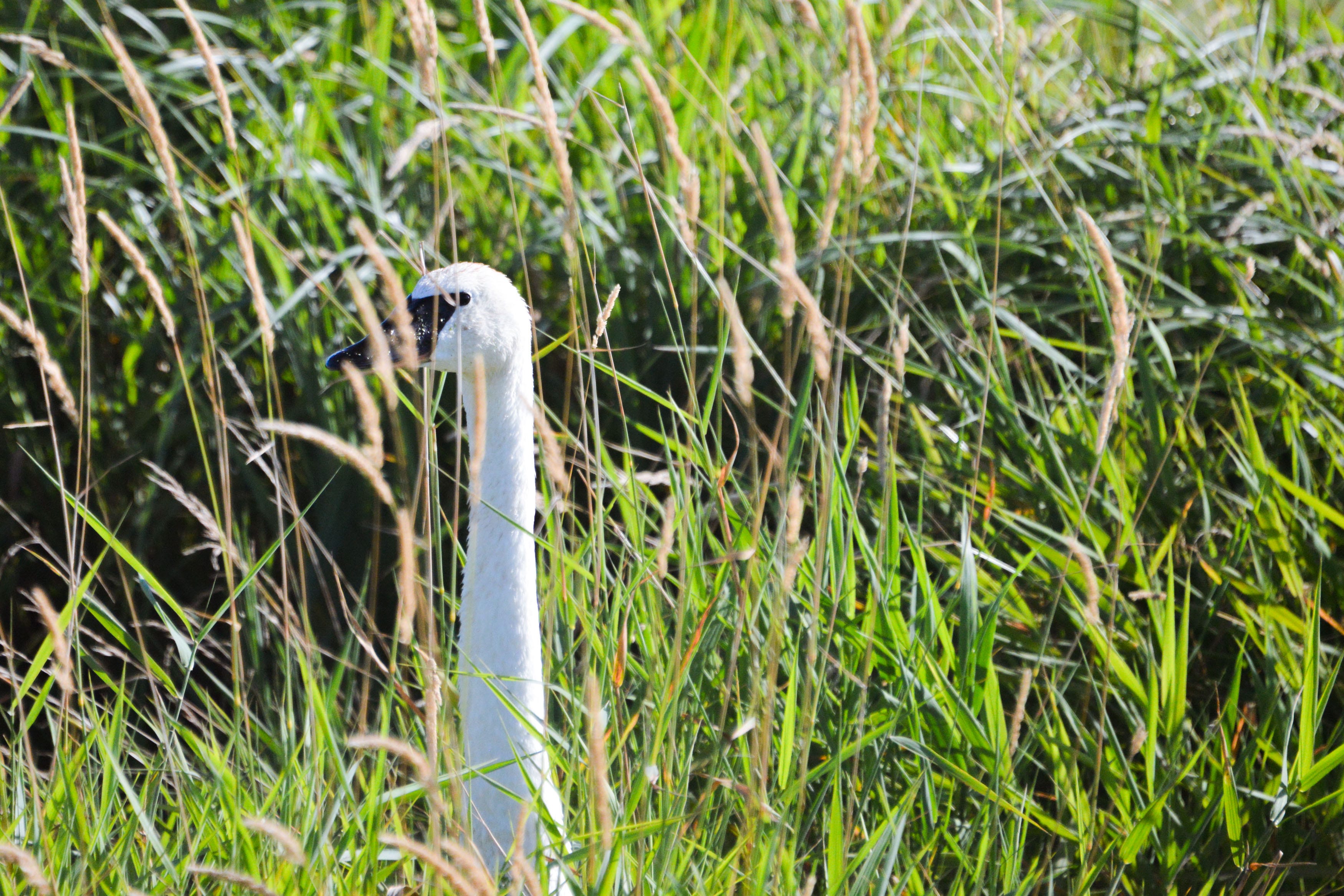
Throwing in some foot-stamping, per Lumsden, confirms a head-bob as a threat response (apparently, it expresses an inner conflict between a fight-or-flight response and “fear of possible consequences”). I don’t know if I would describe what I saw the East River bird doing as stamping, but I do recall it shifting from foot to foot. If it felt any inner conflict, it was probably between “I’m not used to being this close to people” and “please keep tossing me snacks.”
That’s a long way from where Trumpeter Swans found themselves just a century ago, when hunting once drove the species to near-extinction. Our East River swan likely descends from the Ontario population that Harry Lumsden established. In the 1980s, he started the reintroduction program that brought the Trumpeter Swan back to Ontario. By the time Lumsden died in 2022 at age 98, surveys tallied more than 60,000 free-flying Trumpeters across the continent.
The Ontario flocks are the nearest wild Trumpeters to New York, and this bird doesn’t bear any physical signs (i.e. leg bands or trimmed toes) of having originated in captivity.
In the absence of this evidence, a 2018 iNaturalist sighting of a Trumpeter Swan in a Staten Island park was still presumed to be an escapee, though—possibly only because Trumpeter Swans aren’t otherwise expected in New York City. As far as I know, this observation, buried with the “casual” designation for captive organisms, didn’t make it to the birding community and was never followed up on.
Still, I’m fine with calling the East River bird “New York City’s first Trumpeter Swan” rather than “the first Trumpeter Swan in New York City to be accepted by consensus as being of wild origin, because there was a 2018 sighting on Staten Island that birders didn’t investigate because it was presumed an escapee, and also we’ll probably be waiting on New York State Avian Records Committee’s official conclusion about the East River bird’s origin for a while, given that their ruling for the 2024 Rockland County Trumpeter Swan isn’t out yet, but ‘wild origin’ is a loaded term for a descendant of a (re)introduced population anyway, especially since the extent of the species’ historic range in Ontario is unclear…”
Similarly uncertain is what’s going on between it and its Mute Swan companion. I don’t think they’ve left each other’s sight since the Trumpeter arrived, but this alone isn’t strong evidence that they’re considering pairing up. I think “situationship” is more appropriate and less anthropomorphic than it might sound at first: put together by circumstance, they’re enjoying an ambiguously defined and slightly codependent not-quite-a-relationship.
Here’s what we can say for sure about this swan: It’s majestic, it doesn’t mind the crowds, and it can fend for itself (with the help of its interspecies companion). I even saw it tentatively picking at some algae on the walls of the Wallabout Channel.
So by all means, admire this Trumpeter Swan. Go see it if you can (I went three times last month!). It’s large, beautiful, and fearless. It photographs well. Give it a bit of attention (though perhaps not food). I only ask one thing: Please don’t give it a name.
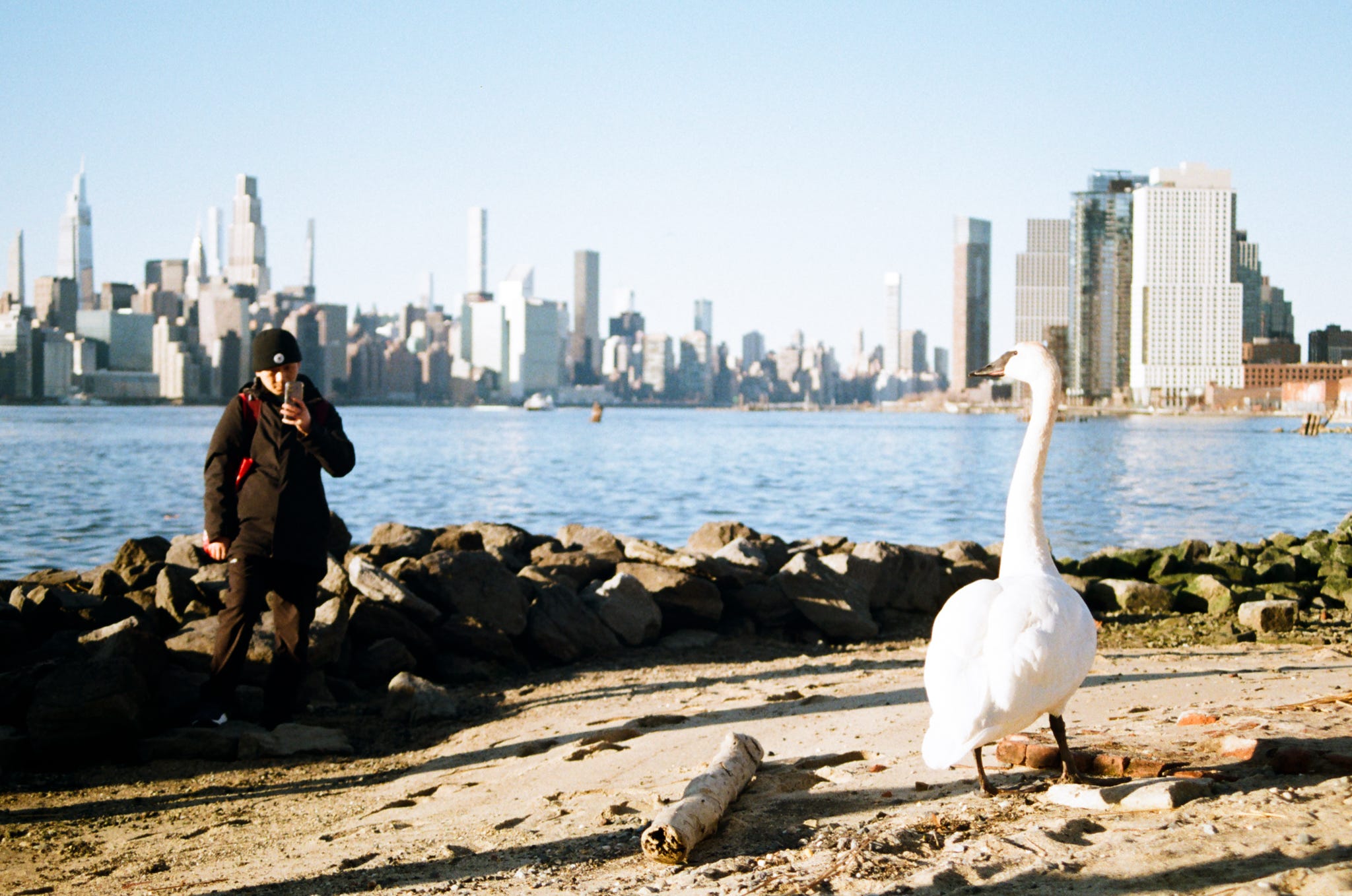
Photo details
* Canon R7 and Canon 50mm 1:1.8 lens.
** Canon R7 and Sigma 150–600 1:5–6.3 lens.
† Nikon D800 and Nikkor 28–300mm 1:3.5–5.6 lens.
†† Canon AE-1 and 50mm Canon 1:1.8 lens on Kodak Gold 200 35mm film, developed and scanned by Full Spectrum Photo.
I loved getting to see this Trumpeter in Brooklyn, and your post made me appreciate it even more!